In performance marketing, growth is often treated as the ultimate goal: more leads, more calls, more volume.
But anyone who has scaled a campaign, a partner network, or an acquisition channel knows that growth can come at a cost. As volume increases, quality can become harder to maintain – which means conversion rates decline and consumer experiences suffer.
This has led many organizations to view scale and quality as opposing forces. In reality, sustainable scale is usually the result of quality.
The strongest growth engines are built by creating systems where quality drives better outcomes, and those outcomes create the signals needed to grow efficiently.
Why Scale Often Breaks Quality
As organizations expand, complexity increases as new traffic sources are added, new partners are onboarded, consumer behaviors evolve, and operational demands multiply.
Processes that worked at smaller volumes can begin to break down under greater scale.
When businesses prioritize growth metrics without maintaining standards, they often see lower conversion rates, rising acquisition costs, increased fraud, and diminished buyer confidence. What appears to be growth on paper can actually create inefficiencies throughout the ecosystem.
The reality is that scaling exposes quality problems.
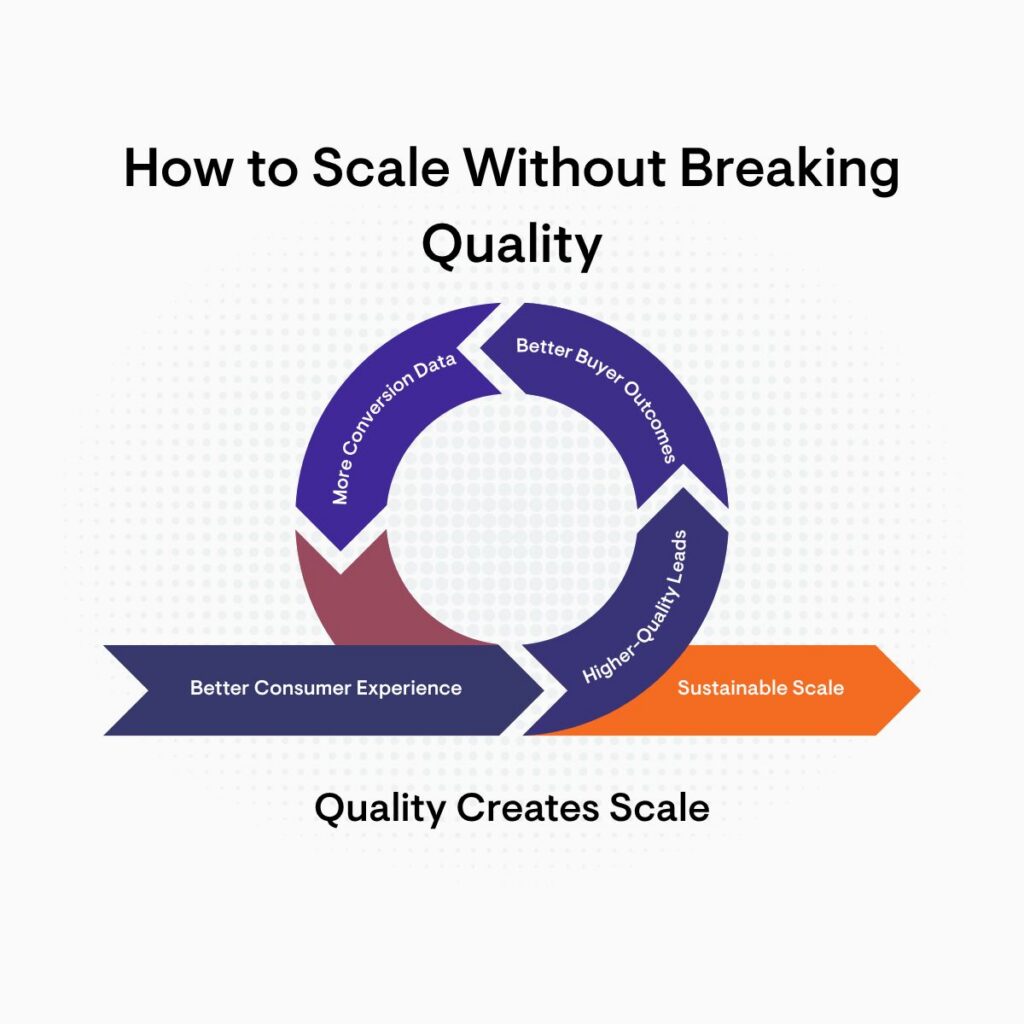
The Quality-to-Scale Flywheel
The most sustainable growth strategies follow a different model. Rather than treating quality as a constraint, they treat it as the foundation for scale.
It starts with the consumer experience.
When consumers encounter relevant offers, clear expectations, and seamless engagement opportunities, they’re more likely to take meaningful action. Whether that’s submitting a form, requesting a quote, or placing a phone call, a positive experience creates stronger intent.
That stronger intent leads to higher-quality leads.
Higher-quality leads generate better buyer outcomes: stronger conversion rates, improved return on investment, and greater confidence in the traffic they receive.
Those successful outcomes create valuable conversion data.
The more outcome data available, the easier it becomes to understand which traffic sources, campaigns, and consumer journeys are producing results. These signals enable smarter optimization decisions and more efficient allocation of marketing spend.
And as optimization improves, the consumer experience improves as well.
The cycle repeats.
Better consumer experiences lead to higher-quality leads. Higher-quality leads drive better buyer outcomes. Better outcomes generate stronger signals. Stronger signals enable smarter optimization. And smarter optimization supports sustainable scale.
In this model, quality doesn’t slow growth, it accelerates it.
Building Systems That Protect Quality
Creating this flywheel requires systems designed to maintain quality as volume increases.
First, organizations need visibility into performance. Conversion tracking, outcome reporting, and real-time analytics create the feedback loops necessary for continuous improvement. Without accurate data, optimization becomes guesswork.
Second, automation must be paired with guardrails. As campaigns scale, manual oversight becomes increasingly difficult. Automated routing, fraud detection, compliance monitoring, and quality controls help ensure that performance standards remain consistent even as volume grows.
Finally, technology plays a critical role.
Platforms like CallThread are designed to help organizations scale efficiently by combining campaign management, call tracking, reporting, routing, and quality safeguards into a single operational framework. By centralizing these functions, businesses can maintain greater control over performance while supporting growth.
The Future of Scale Is Better Signals
As AI and automation become increasingly embedded in performance marketing, quality signals will become even more important.
The organizations that succeed won’t necessarily be the ones generating the most leads or calls. They’ll be the ones creating the strongest feedback loops between consumers, publishers, and buyers.
In an increasingly data-driven ecosystem, better outcomes create better signals—and better signals create better growth.
That’s why the future of scale isn’t about sacrificing quality for volume.
It’s about building systems where quality creates scale.